Guldveterinären vaccinates your cat/kittens against the viral diseases feline panleukopenia and cat flu. Cats over 3 months old travelling abroad must be vaccinated against rabies.
This service is only offered (at 10:00) if you live within 15 minutes’ travel of Vasastan. If I have a regular visit in your area in the afternoon, the service may be offered then. This time (around 14:30) requires good flexibility, however, as the earlier afternoon booking may change.
Vaccination against feline panleukopenia
Feline panleukopenia (feline distemper) is caused by feline parvovirus. Thanks to Sweden’s good vaccination coverage, it is now a relatively rare disease. However, it still exists in the environment and is a danger to unvaccinated cats, especially in areas with many unvaccinated cats.
Cats that fall ill get fever, abdominal pain and severe diarrhoea. It is not unusual for them to die suddenly without previous symptoms. Pregnant cats miscarry or give birth to kittens with brain damage.
The virus is very resistant and contagious and can easily be carried in, e.g. on shoes. This means that even indoor cats are at real risk. The recommendation is therefore that all cats in Sweden are vaccinated against feline panleukopenia. Vaccination gives very good protection.
The vaccine Nobivac Tricat contains live, attenuated feline panleukopenia virus, feline calicivirus and feline herpesvirus type 1.
Nobivac Tricat is given to kittens at 8–9 and 12–14 weeks of age and at 1 year. After that, it depends on whether they are in the high-risk or low-risk group. Cats that go outdoors, live with many other cats, live in a shelter, or attend shows or boarding catteries are in the high-risk group. They should be vaccinated every three years against both panleukopenia and cat flu, and against cat flu in the years in between. Cats that live only indoors with few other cats are in the low-risk group. They should be vaccinated every three years against panleukopenia and cat flu.
More information about feline panleukopenia is available from the Swedish Veterinary Agency (SVA).

Vaccination against Cat flu
Cat flu is often a complex of several disease-causing viruses and bacteria. These cause inflammation of the cat’s nasal/eye membranes and airways. The complex often includes herpesvirus, calicivirus, chlamydia (bacterium), mycoplasma (bacterium) and/or bordetella (bacterium).
Young cats, cats with weakened immune systems and unvaccinated cats are usually hit hardest by cat flu. They get swollen mucous membranes, a runny nose, cough, fever and, at worst, pneumonia and death. Vaccination gives good but not 100% protection, as so many different disease-causing strains of viruses and bacteria are involved. Symptoms are, however, considerably milder in a vaccinated cat.
The vaccine Nobivac Ducat contains live, attenuated feline calicivirus and feline herpesvirus type 1.
Nobivac Ducat is given in the years between panleukopenia vaccinations to all high-risk cats (cats that go outdoors, live with many other cats, live in a shelter, or attend shows or boarding catteries).
More information about cat flu is available from the Swedish Veterinary Agency (SVA).

Vaccination against Rabies
Rabies is fatal, spreads between species and is caused by a lyssavirus.
Rabies has not been seen in domestic animals in Sweden since 1886. Vaccination gives good protection.
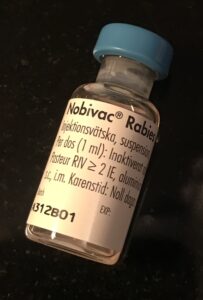
The vaccine Nobivac Rabies contains an inactivated rabies virus strain (Pasteur RIV).
Nobivac Rabies is given every 3 years after a primary vaccination.
The cat must be over 3 months old and have a legible tattoo (documented as done before 3 July 2011) or be microchipped before the primary vaccination is given. After the primary vaccination it takes 21–28 days to reach maximum protection. By law, at least 21 days must pass before the cat can travel abroad. The vaccination must be entered in an EU pet passport to be valid.
More information about rabies is available from the Swedish Veterinary Agency (SVA).
Side effects that can occur with all types of vaccination
The most common side effect is brief but intense itching at the injection site (mainly with rabies vaccine). Other, less common side effects include local skin reactions, a slightly tender swelling (1–2 days) or a temporary lump at the injection site. Occasional cats may get a slight temporary rise in body temperature (up to 40 °C) for 1–2 days.
Sneezing, coughing, nasal discharge and some lethargy or reduced appetite may in some cases be seen for up to two days after vaccination. In very rare cases, the vaccine can cause hypersensitivity reactions (itching, breathing difficulties, vomiting, diarrhoea and collapse). If so, contact a veterinary clinic immediately.
Via the contact form you can book vaccination for your cat.